Dozens of residents talk to Mayes about data centers
Regional News

Audio By Carbonatix
9:55 PM on Wednesday, October 14
(The Center Square) – What was meant to be a stop on the campaign tour for Arizona’s attorney general deep in the heart of Mesa became a one-topic free-for-all instead on Wednesday night.
The city of about 500,000 people, near Phoenix, is where Democratic Attorney General Kris Mayes came to lay out her vision for data center development. But most of the town hall at the Eagle Community Center was spent talking about a particular 38-acre tract of land in the southern fringes of the Phoenix city limits.
As The Center Square covered on Wednesday morning, Mayes’ calls for a data center moratorium have been met by raised eyebrows and criticism from business officials, including executives from the state and Phoenix area chambers of commerce.
One such criticism has come from the campaign of Mayes' opponent in the Nov. 3 general election, Republican State Senate President Warren Petersen of Gilbert. His campaign manager, Chad LeBeau, said there's a lack of consistency regarding data center development in Arizona.
“Kris Mayes has spent years trying to get data centers to come to Arizona," LeBeau said in an email to The Center Square. "Now that she's on the ballot, she wants a total halt, a position even Governor [Katie] Hobbs rejects. Mayes doesn't have a policy; she has a poll. When the winds shift, she flips.”
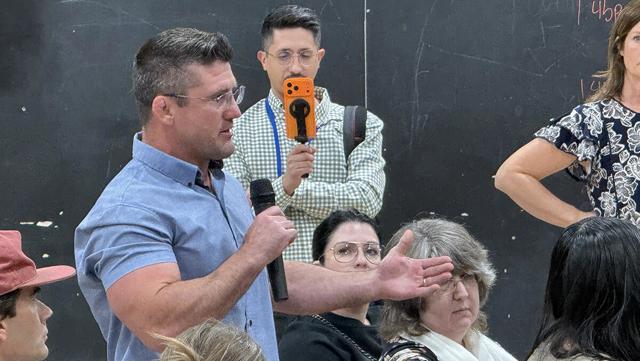
Regardless, that opposition couldn’t beat back the mood in the East Valley on Wednesday night, with dozens of attendees taking to the microphone to discuss the hot-button subject, forcing Mayes’ staff to cut the meeting at 7 p.m., two hours after it began.

Arizona Attorney General Kris Mayes on Oct. 14, 2026
Arizona Attorney General Kris Mayes talks about data centers during a town hall meeting in Mesa, Ariz., Oct. 14, 2026. Photo: Christopher Boan / The Center Square
The 150 or so attendees in the 180-seat gym at the Eagle Community Center were red-hot and bothered by the Menlo Digital data center development in Ahwatukee, a bedroom community that’s technically part of Phoenix, albeit on the southern side of South Mountain.
As the crowd settled in for the two-hour town hall, with attendees passing time by knitting or scrolling their phones between questions, Mayes admitted what Phoenix Chamber CEO Danny Seiden and others said — that she has no legal authority to issue a data center moratorium on her own.
Instead, the former member of the Arizona Corporation Commission called on that body, as well as the Arizona Legislature and fellow Democrat, Hobbs, to do the work needed to “press time out” on the industry.
“I am limited to the tools that I have as your attorney general, which is the bully pulpit and nuisance law,” Hobbs told the crowd Wednesday.
More than half of the people in attendance raised their hands when Mayes asked if they came to discuss the Menlo development.
One such attendee was Tina Charon, who has lived in Phoenix for more than 30 years, spending her career as a project manager for a semiconductor manufacturing firm.
Charon told The Center Square that the development in her backyard has disturbed her quality of life, spurring her to join a neighborhood activism group called the Ahwatukee Community Alliance.
Charon said she hoped her state's attorney general would fight the very industry that Charon worked for, helping her sleep better at night.
"We're all hoping that she can intervene and do anything to help reduce the nuisance in our lives," Charon told The Center Square. "This is going to impact thousands of homes of people who were there well before that data center was even a dream. So I'm hoping she'll help in some way."
Mayes cited her past work on the ACC as a reason why she will seek to use the state’s nuisance law. That law applies to everything from being “injurious to, indecent, offensive to the senses” to selling, offering to sell, transferring or disseminating items deemed to be offensive within 2,000 feet of any public or private school, public park or residential neighborhood.
“One of the things that has alarmed me the most, which is that it seems very obvious to me, and this is one of the reasons that we formally intervened in opposition to the Arizona Public Service and Tucson Electric Power rate increases," Mayes said at the town hall.

Town hall on data centers in Arizona
Arizona Attorney General Kris Mayes listens to residents talk about data centers during a town hall in Mesa, Ariz., Oct. 14, 2026. Photo: Christopher Boan / The Center Square
“We were in opposition to those proposed rate increases in front of the Arizona Corporation Commission, because we are opposing a 14% APS rate increase and a 13% TEP rate increase because I believe it's unnecessary, unjust, and is being fueled by data centers, at least in part.”
In her post-town hall press scrum, Mayes addressed what she’d like to see from the data center and AI industries at large, to satisfy her concerns.
Chief among them is having residents have more of a say in where and when such facilities are built, with Mayes pitching the idea of having a neighborhood, town or entire city voting on data center development before they can break ground on them.
“You have to ask yourself, 'Why would you drop an industrial-scale, hyper-scaled AI data center in the middle of Ahwatukee?' ” Mayes told reporters. “And so, number one, pick the right place. I'm not flatly against data centers. Maybe there is a place in the middle of almost nowhere Arizona where these things would be appropriate, where maybe a community would want one.
“But it is very obvious that they are choosing locations that were designed for a lower scale, lower level commercial operation, and then they are somehow flipping that into this gigantic industrial facility that can give off constant noise and pollution and possibly even constant air pollution if they're using diesel generators to power them at any time, and so there's a lot to be investigated here," she said.